
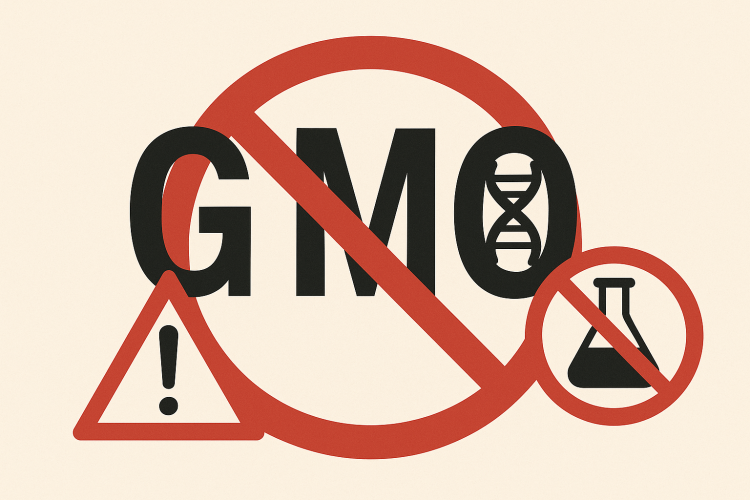
As stated in ‘Turkish Regulation on the Principles and Implementation of Organic Farming Article 4 – Definitions’, published in the Official Gazette No. 27676;
Genetically Modified Organism (GMO): A living organism, other than humans, obtained through gene transfer using modern biotechnological methods.
GMO and products: Products that are partially or completely obtained from GMOs, contain GMOs, or are composed of GMOs.
According to Article 5 – (1) General rules of organic farming;
d) Food, feed, food additives, plant protection products, fertilizers, soil conditioners, seeds, microorganisms, products used for animal health, and animals that are partially or completely obtained from GMOs, that contain GMOs, or that are composed of GMOs cannot be used in organic farming.
e) Operators who use non-organic products that are not food or feed must ensure that the supplier confirms that the supplied product has not been produced from GMOs or products produced by GMOs with the Supplier Declaration included in Annex-12 of this Regulation. (You can access Annex-12 by clicking on the red-lettered “annexes” at the bottom of the Regulation via the link https://mevzuat.gov.tr/mevzuat?MevzuatNo=14217&MevzuatTur=7&MevzuatTertip=5).
According to Article 10 – Sowing and planting (1)(ç); In organic farming, GMO propagation materials cannot be used. Similarly, according to (1) a)-1: Seed; it must be genetically unmodified, with no external intervention in the DNA sequence in the fertilized cell nucleus, not treated with synthetic pesticides, radiation, or microwave, and must have been produced in accordance with the provisions of this Regulation.
According to Article 16 – (1) Rules for organic animal production (b); Animals brought from organic enterprises, fed entirely with organic feed, genetically unmodified, resistant to the environment, climate conditions, and diseases, are used as breeding animals.
According to Article 18 – (1) Rules for animal health and veterinary intervention (ç); In organic animal husbandry, the genetic structure of animals cannot be altered and genetically modified organisms cannot be used as inputs in organic animal production. Genetic engineering methods for animal breeding are not allowed.
According to Article 28 – (1) Processing and packaging of organic products (g); g) Organic products are produced without the use of genetically modified organisms or products obtained from these organisms.
(EU) 2018/848 – Regulation of the European Parliament and Council of 30 May 2018 on organic production and labeling of organic products, repealing Council Regulation (EC) No 834/2007 – under Title III Production Rules, Article 11 Prohibition on the use of GMOs, sets out detailed rules regarding genetically modified organisms. Accordingly;
In organic production, GMOs, products produced from GMOs, and GMO-derived products cannot be used in food or feed or as food, feed, processing aids, plant protection products, fertilizers, soil conditioners, plant reproductive material, microorganisms, or animals.
Regarding products produced from GMOs for food and feed, for the purposes of the prohibition referred to in paragraph 1, operators may rely on the labels of a product affixed under Directive 2001/18/EC, Regulation (EC) No 1829/2003 of the European Parliament and of the Council, or Regulation (EC) No 1830/2003, and any accompanying document provided by the European Parliament and Council or accordingly.
According to the legal provisions referred to in paragraph 2, in cases where such a label is not affixed to the product or a document does not accompany it, unless there is other information indicating that the labeling of the relevant products does not comply with those legal provisions, operators may assume that no GMOs and no products produced from GMOs have been used in the production of purchased food and feed.
Regarding products not covered by paragraphs 2 and 3, for the purposes of the prohibition referred to in paragraph 1, operators using non-organic products purchased from third parties shall require the supplier to confirm that those products have not been produced from GMOs or produced by GMOs.
According to Regulation (EU) 2018/848, its complementary Regulation (EU) 2021/1698, in Annex IV, Part B, lists non-compliances considered ‘critical’, and the intentional use of GMOs by the operator is included in this list.
As of 15 June 2025, the consolidated (EU) 2021/1165 Regulation on authorizing certain products and substances for use in organic production and establishing their lists, under Annex VI – pursuant to Article 45(2) of Regulation (EU) 2018/848 concerning products and substances authorized for use in organic production in certain regions of third countries, states that;
Microorganisms, including viruses not of GMO origin and not produced using GMO-derived culture media, may be used as biological control agents. However, they must comply with the legislation of the relevant third country (here Turkey), be exempt from maximum residue levels according to Codex Alimentarius Guidelines CXG 97-2022, be listed in Annex IV of Regulation (EC) No 396/2005 of the European Parliament and Council, or have specific maximum residue levels established in the said Regulation.
According to the USDA National Organic Program (NOP),
In § 205.105, substances, methods, and ingredients allowed and prohibited in organic production and processing are listed. Accordingly, under item e; except for vaccines approved under § 205.600(a), ‘excluded methods’ cannot be used in the production and processing of organic products.
In § 205.2 Definitions, ‘excluded methods’ are defined as ‘a variety of methods used to genetically modify organisms or influence their growth and development in ways not possible under natural conditions or processes and not considered compatible with organic production.’ These methods include cell fusion, microencapsulation and macroencapsulation, and recombinant DNA technology (including gene deletion, gene doubling, introduction of a foreign gene, and changes in the positions of genes when achieved through recombinant DNA technology).
Questions and answers prepared by the USDA NOP that address some points you may wonder about can be found in the Policy Memorandum at the following link:
https://www.ams.usda.gov/sites/default/files/media/NOP-PM-11-13-GMOClarification.pdf