
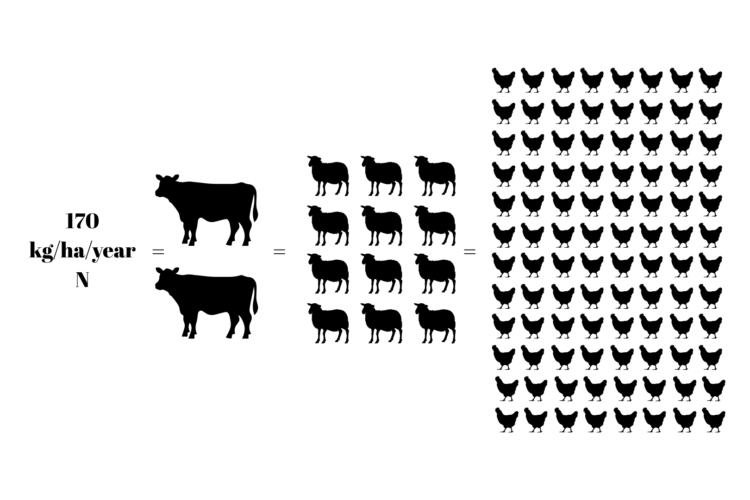
Equivalent Number of Animals for 170 kg/ha/year Nitrogen Limit
One of the challenging issues in Organic Farming Regulations is the subject of “Equivalent Number of Animals for 170 kg/ha/year Nitrogen Limit.” The 170 kg/ha/year Nitrogen Limit was explained in detail in another article of ours. While the Org-TR Regulation No. 27676 and Regulation (EU) 2018/848 address this issue, there is no regulation on this subject in the U.S. National Organic Program (NOP) regulation. We summarized the NOP’s approach to Animal Manure in our article titled “Calculation of Animal Manure in Organic Farming: 170 kg/ha N Limit.”
Now let us examine the issue for both regulations;
1.) Org-TR Regulation No. 27676 Article 16(1)(ç):
Animals must have access to pastures, open-air exercise areas, or open spaces. The number of animals per unit area on pastures and open spaces shall be limited to a level that can provide sufficient animal manure for plant production in the production unit. Animal density, in terms of the amount of nitrogen spread, shall be determined at a number not exceeding 170 kg/N/ha/year on the utilized agricultural area. When this amount is exceeded, the operator must either acquire additional land in the same region or ensure this possibility through neighboring enterprises with the knowledge of the authorized body. The authorized body may reduce animal density for environmental protection purposes.
Furthermore, according to the same regulation, Article 21:
- a) In organic plant production areas, the total amount of fertilizer applied to the land shall not exceed 170 kg/N/ha/year. According to this amount, the maximum number of animals is determined in the table in Annex-4 of this Regulation. (Click here for the annex of the Regulation where you can find the mentioned Table.)
- b) Organic livestock production enterprises distribute their surplus manure by contracting with other operators who produce in accordance with this Regulation. In the contract; the maximum 170 kg pure nitrogen per hectare per year applied on the utilized agricultural land is calculated and determined from the part provided by this fertilization.
- c) Storage sites of animal manures must be designed to prevent soil or water pollution by direct runoff or leakage.
ç) In the contract that the operator will make with the authorized body, the location and description of the facilities built for manure storage, the plan for manure spreading, and the correspondence made with other enterprises shall be included.
In summary, according to the Org-TR Regulation No. 27676;
In our agricultural enterprise (plant production or animal production), if the number of animals exceeds the maximum animal number in the table in Annex-4 of the Regulation (we must consider these figures as the number of animals per hectare), then we must either increase the size of the land to accommodate the animals or distribute the surplus manure to other operators engaged in organic farming by making a contract.
Let’s examine the issue with an example:
Scenario:
- Total land size of our agricultural enterprise: 20 decare,
- Number of animals we own: 8 dairy cows,
- According to the table in Annex-4 of the Regulation, the number of dairy cows per hectare: 2,
- Amount of manure we have: 70 tons
Calculations
Number of animals per hectare in your enterprise:
8 dairy cows / 20 decare (=2 ha) = 4 dairy cows/ha,
With the assumption of “0.5% N” per manure weight:
Total N (kg) = 70,000 kg × 0.005 = 350 kg N
Nitrogen per hectare = 350 kg ÷ 2.0 ha ≈ 175 kg N/ha
The maximum amount of manure you can apply to avoid exceeding the 170 kg/ha limit:
(170 × 2)/0.005 = 68,000 kg
So, you have 2,000 kg surplus manure.
In this case, you have 2 solutions:
- Obtain 20 more decare of land,
- Give the 2,000 kg surplus manure to another organic farming operator under a contract.
The decision is yours 😊
2.) Regulation (EU) 2018/848 Annex II, Part 3, Section II:
1.6.6. The total stocking density shall not exceed the limit of 170 kg of organic nitrogen per year and hectare of agricultural area.
1.6.7. To determine the appropriate density of livestock referred to in point 1.6.6, the competent authority shall set out the livestock units equivalent to the limit referred to in point 1.6.6, following the figures laid down in each of the specific requirements per type of animal production.
The issue of Equivalent Number of Animals for 170 kg/ha/year Nitrogen Limit is addressed almost identically in the EU and Turkish Organic Farming Regulations. With one difference; in the latest update of Regulation (EU) 2018/848, the table of “maximum number of animals per hectare” no longer exists. In fact, point 1.6.7 explains how these figures should be derived.
The table in Annex-4 of Org-TR Regulation No. 27676 was taken from Annex-4 of the repealed Regulation (EU) No 889/2008.
According to Regulation (EU) 2018/848, it will be beneficial for operators to contact their control and certification body regarding this issue when necessary.
3.) U.S. National Organic Program (NOP)
As we pointed out in our article “Manure Calculation,” the U.S. National Organic Program (NOP) does not set a limit of 170 kg/ha N. Therefore, there is no regulation in the form of an equivalent number of animals per 170 kg/ha/year nitrogen limit. For information on how manure use and nitrogen management are handled under the NOP, please refer to item “4) How do USDA NOP (U.S.) organic rules address manure?” in our “Animal Manure Calculation” article.