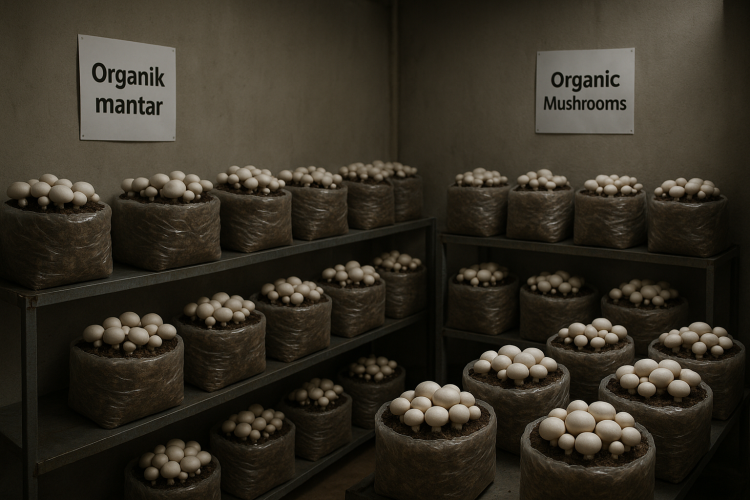
Organic Mushroom Production
Organic mushroom production is explained in the “Regulation on the Principles and Implementation of Organic Farming” published in the Official Gazette No. 27676, under the second section titled “Plant Production, Mushroom and Yeast Production by Organic Farming Method.” Accordingly:
Article 14 – Mushroom Production:
(1) In organic mushroom production; mixtures containing the following components are used in compost making.
a) Farmyard manure and animal excrement coming from an enterprise where organic farming method is applied, as specified in Annex-1 of the Turkish Organic Farming Regulation; in cases where such manure is not available, before composting, farmyard manure and animal excrement that meet the requirements of this section may be used at a rate not exceeding 25% of the total content excluding casing material and water,
b) Straw-like agricultural products obtained from lands cultivated by the organic farming method,
c) Peat not chemically treated,
ç) Wood not chemically treated after cutting,
d) Soil in its natural state and water suitable for irrigation,
e) Mineral substances permitted for use in Annex-1 of the Turkish Organic Farming Regulation.
In relation to organic production and the labeling of organic products, organic mushroom production is explained in the European Parliament and Council Regulation (EU) 2018/848 of 30 May 2018, under Annex II Part I Crop Production Rules, Article 2.1. Accordingly:
For the production of mushrooms, substrates may be used if they are
composed only of the following components:
(a) Farmyard manure and animal excrement:
(i) either from organic production units or from in-conversion units in their second year of conversion; or
(ii) referred to in point 1.9.3 (fertilizers and soil conditioners allowed in organic production – see also (EU) 2021/1165), only when the product referred to in
point (i) is not available, provided that that farmyard manure and animal excrement do not exceed 25 % of the weight of total components of the substrate, excluding the covering material and any added water, before composting;
(b) products of agricultural origin, other than those referred to in point (a), from organic production units;
(c) peat, not treated with chemical products;
(d) wood, not treated with chemical products after felling;
(e) mineral products referred to in point 1.9.3, water and soil.
It should be noted that the production rules laid down in Regulation (EU) 2018/848, Part III also apply to mushroom production and that all inputs and practices permitted under the Regulation must be listed in advance in your organic system plan and submitted to the control body with which you are contracted for approval.
In the United States Department of Agriculture (USDA) National Organic Program (NOP), organic mushroom production is explained in much greater detail compared to other regulations, effective from March 21, 2025. The final date for full compliance with the rules specified in the Regulation for operators producing organic mushrooms (including organic spawn producers) is March 22, 2027. According to the USDA NOP, to better understand the process of publishing organic mushroom production rules, you are advised to review the link provided and confirm the information with your contracted control body:
§ 205.2 Definitions
The definition and terms related to mushrooms are as follows, and it is essential to fully understand these terms in order to comprehend the organic mushroom production rules defined by USDA NOP.
Crop; Pastures, cover crops, green manure crops, catch crops, mushrooms, or any plant or part of a plant intended to be marketed as an agricultural product, fed to livestock, or used in the field to manage nutrients and soil fertility.
Mushroom; The fleshy, spore-bearing fruiting body of a fungus.
Mushroom Mycelium; A mass of branching, thread-like hyphae (fungal structures).
Mushroom Spawn; Mushroom spawn media colonized by mushroom mycelium that can be used to inoculate mushroom substrate.
Mushroom Spawn Media; The base material, such as grain, wood materials, or minerals, used to make mushroom spawn.
Mushroom substrate; The base material, such as grain, wood materials, composted materials, and/or other agricultural materials, on which mushroom production occurs.
Reminder: § 205.2 defines “Wild crop; Any mushroom, plant, or portion of a plant that is collected or harvested from a site that is not maintained under cultivation or other agricultural management.” As with all other crops, cultivated mushroom products must comply with the crop production rules explained below, and if wild mushrooms are concerned, the wild crop production rules must be followed (see § 205.207).
§ 205.210 Mushroom Production Practice Standard
(a) The producer must manage mushroom production in compliance with the provisions of § 205.200, § 205.201, § 205.202, § 205.203(e) and § 205.206(a)(2) and (3) and (b) through (f), as applicable. The producer may manage plant nutrients for mushroom production in accordance with the provisions of § 205.203(d).
Explanation: The regulation numbers specified in paragraph (a) are included in “Subpart C—Organic Production and Handling Requirements.” Organic mushroom producers must comply with the following requirements:
Implement the production practices specified in this subpart, to conserve or improve the natural resources of the operation, including soil and water quality,
Prepare the organic system plan as specified in § 205.201,
Comply with the land requirements specified in § 205.202,
As prohibited in § 205.203(e):
Any fertilizer or composted plant and animal material containing a synthetic substance not included on the National List of synthetic substances allowed for use,
Sewage sludge,
Burning of crop residues solely as a means of disposal,
Take sanitation measures as specified in § 205.206(a)(2) to remove disease vectors, weed seeds, and habitats for pests,
As specified in § 205.206(a)(3): Use Cultural practices that enhance crop health, including selection of plant species and varieties with regard to suitability to site-specific conditions and resistance to prevalent pests, weeds, and diseases,
As specified in § 205.206(b): control pests through mechanical or physical methods,
As specified in § 205.206(f): do not use lumber treated with arsenate or other prohibited materials,
As specified in § 205.203(d): manage plant nutrients and soil fertility to maintain or improve soil organic matter content in a manner that does not contribute to contamination of crops, soil, or water by plant nutrients, pathogenic organisms, heavy metals, or residues of prohibited substances.
(b) The producer must manage mushroom substrate and mushroom spawn media, including spent mushroom substrate and mushroom spawn media, in a manner that does not contribute to contamination of crops, mushroom spawn, mushroom substrate, soil, or water by pathogenic organisms, heavy metals, or residues of prohibited substances.
(c) Mushroom substrate may consist of the following materials:
Composted plant and animal materials. Compost used in mushroom substrate must be described in the organic system plan. It must be produced through a process that maintains a temperature of at least 131 °F (61 °C) for at least three days for three days;
Uncomposted plant materials. Uncomposted plant materials must be organically produced: Except, that, nonorganically produced uncomposted plant materials may be used when a functionally equivalent organically produced material is not commercially available. Prohibited substances must not be applied to nonorganically produced uncomposted plant materials after harvest. Operations that use nonorganically produced uncomposted plant materials in mushroom substrate (except for wood materials allowed under paragraph (c)(3) of this section) must describe in the organic system plan:
i. The procedures used to search for organic materials and the records kept to document searches,
ii. The criteria used to evaluate if functionally equivalent organic materials are commercially available; and,
iii. The recordkeeping system used to document purchases of nonorganic materials, including a summary of the type(s) and total amount of each nonorganic material used in mushroom substrate.Wood chips, sawdust, logs, or other materials derived from wood that have not been treated with a prohibited substance after harvest;
Nonsynthetic substances, except those on the National List of nonsynthetic substances prohibited for use in organic crop production (see § 205.602); and ,
Synthetic substances on the National List of synthetic substances allowed for use in organic crop production (see § 205.601)
d) Mushroom spawn must be organic: Except, that, nonorganic mushroom spawn may be used to produce an organic crop when an equivalent organic mushroom spawn is not commercially available.
(1) Organic mushroom spawn requirements
(i) Agricultural materials used as mushroom spawn media must be organic: Except, that, nonorganic wood materials in compliance with paragraph (c)(3) of this section are allowed.
(ii) Mushroom spawn media may contain materials allowed in mushroom substrate at paragraphs (c)(1), (4), and (5) of this section.
(iii) Organic mushroom spawn must be under continuous organic management after the mycelium is applied to the mushroom spawn media.
(2) Organic mushroom operations that produce their own mushroom spawn for their own organic mushroom production must use organic agricultural materials for mushroom spawn media, unless a functionally equivalent organic agricultural material is not commercially available: Except that, wood materials in compliance with paragraph (c)(3) of this section are allowed.
